←Research Index

Case Study

D001

v1.0

2026

Development

Gate of Dream — The Flying Letters Whispering From The Canvas

A temporary immersive case study for validating the complete SIRP research-data pipeline.

Full SIRP research-data pipeline validation and publication-oriented human study.

Spatial InteractionEmbodied InteractionResponsive EnvironmentsHuman–Environment Interaction
Gate of Dream — The Flying Letters Whispering From The Canvas cover

Research Documentation

D001

01 / Overview

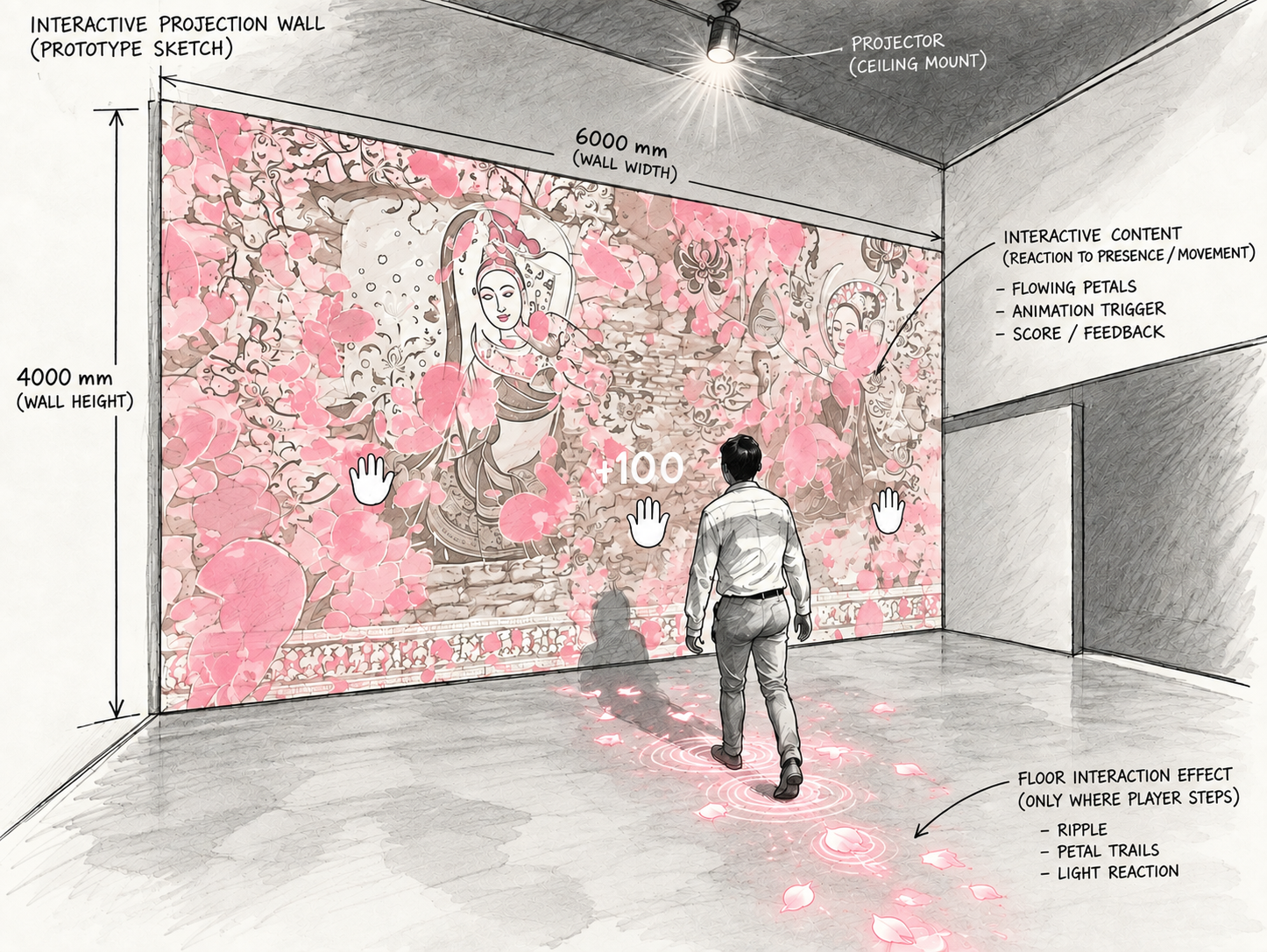
An immersive interactive research deployment examining spatial interaction and participant behavior within a responsive artwork environment while validating the full SIRP research-data pipeline.

D001 is the first complete SIRP case-study deployment and combines immersive media, personalized visitor interaction, spatial tracking, system events, and post-experience research data.

02 / Research Question

“How do participants move, dwell, interact, and respond within a personalized immersive environment, and how can those behaviors be represented through synchronized spatial and interaction data?”

03 / Methodology

Deploy SIRP in a temporary immersive installation and collect synchronized session, position, trajectory, movement, zone, dwell, interaction, system-response, tracking-quality, and questionnaire data for publication-oriented analysis.

04 / System

Four Hokuyo UST-10LX LiDAR sensors provide spatial sensing. A TouchDesigner workstation and media server run the immersive experience, Raspberry Pi 5 provides edge/control functions, and a tablet supports participant-facing interaction.

Runtime

TouchDesigner workstation + media server

Hardware / Compute

TouchDesigner workstation, media server, Raspberry Pi 5, and tablet participant interface.

Sensors

4 × Hokuyo UST-10LX

Edge / Control

Raspberry Pi 5

01

Immersive Environment

02

LiDAR

03

Spatial Tracking

04

Case Study

05

Interactive Installation

06

Research through Design

05 / Deployment

Installation Type

Temporary immersive interactive installation

Deployment Period

2026-12-12 → 2026-12-26

Venue

Fah Lanna Art Museum Chiang Mai, Thailand

Environment

4 m W × 6 m D × 4 m H

06 / Current Outcomes

Planned deployment for validation of the complete SIRP research-data pipeline and collection of publication-oriented human-study data.

Research → Knowledge

Related Knowledge

Methods, technical notes, and reusable knowledge connected to this research.

K01

Design

Scene-Based Interaction

Structuring responsive environments as spatial states and scenes that translate human activity into coherent media behaviour.

A scene-based interaction model for responsive environments that separates sensing from experience behaviour. Spatial observations such as presence, position, area activation, and interaction events are interpreted as states that control scenes, transitions, media layers, and system responses. The approach supports clearer interaction logic, reusable experience structures, and more manageable multi-zone installations.

Responsive EnvironmentsSpatial InteractionInteractive SystemsExperience Design

K02

Technical

Raw Sensor Data to Interaction Data

Transforming continuous LiDAR and depth-sensing measurements into stable spatial observations, interaction states, and research-ready data.

A technical framework for transforming raw spatial sensor measurements into meaningful interaction data for responsive environments. The pipeline separates acquisition, filtering, coordinate transformation, spatial fusion, tracking, area detection, event generation, and research logging so that LiDAR and depth-camera systems can provide reusable spatial observations to real-time experience applications.

Spatial InteractionResponsive EnvironmentsInteractive SystemsSensor Systems

K03

Methodology

Spatial Interaction Logging & Session Architecture

Structuring session identity, trajectories, interaction events, dwell time, and synchronized logs for research-ready responsive environments.

A research-oriented logging architecture for responsive environments that organizes continuous spatial tracking, discrete interaction events, experience states, and system observations around a shared session identity. The approach supports trajectory reconstruction, dwell-time analysis, interaction counts, heatmaps, and cross-system synchronization while keeping research instrumentation separate from real-time experience logic.

Spatial InteractionResponsive EnvironmentsResearch MethodsInteractive Systems

K04

Design

Personalized Spatial Experience Architecture

Designing responsive environments that adapt content, interaction, and spatial behaviour from contextual or participant-specific input without coupling identity directly to experience logic.

A design and system framework for personalized responsive environments in which participant or contextual input is transformed into an abstract experience profile before controlling content, interaction, and spatial behaviour. The architecture separates identification, personalization, experience state, and media response so that installations can provide differentiated experiences without requiring the runtime to depend directly on personal identity.

Spatial InteractionResponsive EnvironmentsExperience DesignInteractive Systems

K05

Technical

Multi-Sensor Spatial Fusion & Coordinate Calibration

Transforming observations from multiple spatial sensors into a shared room coordinate system for robust tracking, interaction detection, and research logging.

A technical framework for calibrating and combining spatial observations from multiple LiDAR and depth sensors within responsive environments. The architecture transforms sensor-local measurements into a shared room coordinate system, manages overlapping observations and occlusion, and produces stable fused spatial estimates for interaction logic and research logging.

Spatial InteractionResponsive EnvironmentsSensor SystemsInteractive Systems

K06

Technical

Modular Sensor Server Architecture

Separating sensing, spatial processing, communication, and real-time media into reusable system layers.

A modular architecture for interactive environments that separates sensor acquisition and spatial processing from real-time media systems. The approach allows LiDAR, depth cameras, Raspberry Pi edge nodes, OSC, TouchDesigner, Unity, and other components to evolve independently while maintaining a reusable interaction pipeline across installations and research environments.

Responsive EnvironmentsSpatial InteractionInteractive SystemsSensor Systems